Struggling with unpredictable demand and wasted stock?
If you’re evaluating supply chain software, you already know the headaches of guessing demand and battling costly overstock or shortages—especially in food and beverage operations.
What really stings is dealing with lost sales or spoilage every single day just because you’re forced to rely on outdated data, clunky spreadsheets, or gut feeling instead of smart predictions.
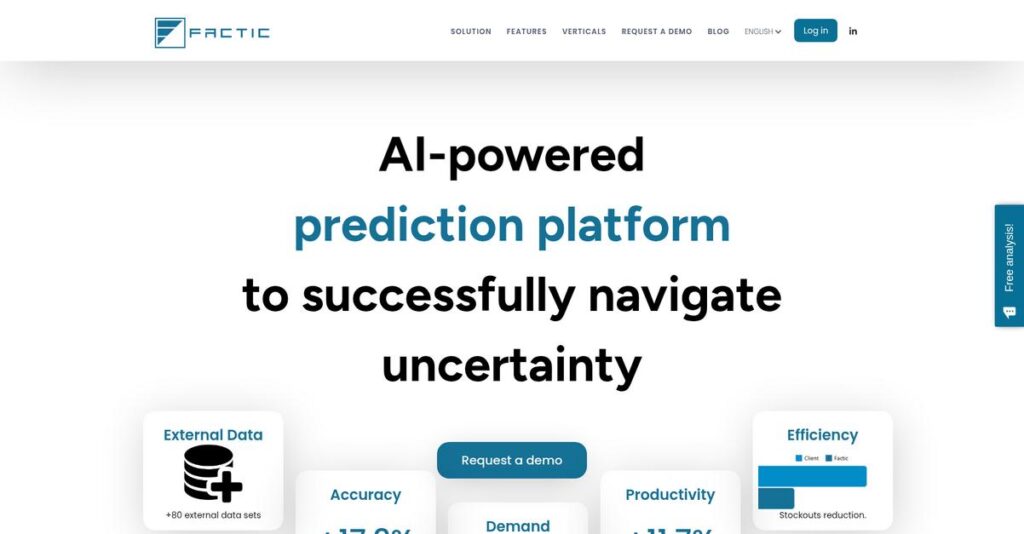
Factic takes a different approach, combining AI and over 80 external data sources to deliver real-time forecasting that actually aligns with your production needs, so you can automate planning and reduce both costs and waste—with less manual work for you.
In this Factic review, I’ll break down how their user-friendly SaaS leverages AI to help your team predict demand and optimize stock, so you can make better decisions without guesswork.
You’ll see exactly what Factic offers, how it works, detailed features, pricing tiers, and top alternatives to help you compare and choose the right solution.
You’ll leave with the features you need to cut waste, streamline operations, and feel confident in your software decision.
Let’s get started.
Quick Summary
- Factic is an AI-driven platform that improves Food & Beverage supply chains by forecasting demand and automating purchasing and production.
- Best for Food & Beverage businesses needing accurate demand forecasts and efficient inventory management.
- You’ll appreciate its integration of internal and over 80 external data sources to deliver precise, actionable predictions.
- Factic offers tiered annual pricing per user, with no public free trial but a free initial analysis available.
Factic Overview
Factic is dedicated to helping Food & Beverage businesses stay ahead of uncertainty by delivering highly accurate AI-driven forecasts and automated supply chain optimization. This focus on predictive analytics lends credibility for companies seeking a proven data-driven approach.
- 🎯 Bonus Resource: While we’re discussing operational improvements, understanding contract lifecycle management software is equally important for streamlining approvals.
In the Food & Beverage sector, Factic specializes in supporting Consumer Packaged Goods, growers, processors, and distribution networks. Their reputation rests on their integration of 80+ external data sources for smarter forecasting, setting them apart from traditional tools and less specialized platforms.
Organizations using Factic range from mid-sized producers to enterprise-level grocers and distributors, validating its fit for both large-scale operations and growing businesses needing robust ERP integrations.
Factic stands out for these core strengths:
- Exceptionally precise AI-powered demand forecasting
- Flexible automation across purchasing and production activities
- Deep integration with major ERP and financial systems
Currently, Factic emphasizes more advanced machine learning and seamless data connectivity, aligning with market demand for real-time, actionable supply chain intelligence.
Let’s dive into the Factic review to discover how their features might fit your business needs.
Factic Features
Struggling to predict sales and operate efficiently?
Factic takes a unified approach with an AI-powered platform designed to solve common food and beverage supply chain headaches. Whether you battle surprise shortages, waste from overproduction, or are scrambling to track the impact of promotions, Factic features are built to drive accuracy and action. Here are the five main Factic features that tackle the most pressing issues in today’s operations.
1. Demand Forecasting
Over-ordering and stock-outs drain your profits.
Food and beverage companies often get stuck relying on gut feel or clunky spreadsheets, which can’t keep up with volatile trends or external factors. That means missed sales or wasted product.
Factic’s AI-driven Demand Forecasting feature changes the game by crunching both your past sales and over 80 external data sets—like weather and population shifts. Using machine learning, it builds highly accurate daily or weekly sales predictions for every product and customer. You get both “Top-Down” and “Bottom-Up” forecast options for different needs.
With these data-driven projections, you keep the right inventory, reduce out-of-stocks, and dramatically cut product waste.
2. Purchasing Automation
Manual purchasing wastes time and money.
Most buyers react to shortages instead of planning ahead, leading to inefficiency and cash tied up in excess stock or costly emergency orders.
Factic’s Purchasing Automation uses your sales forecasts as fuel, recommending exactly what to buy, when, and how much. With this Factic feature, all procurement activity is automated based on business logic—so you ditch guesswork. Your team sees instantly updated and prioritized buying lists right inside the interface, making action a no-brainer.
That means less stress, lower working capital needs, and a lot fewer “out of stock” moments.
3. Production Optimization
Are your production runs always in sync with sales?
Many manufacturers either overproduce and waste product, or scramble to catch up—and both scenarios torpedo margins and planning.
Production Optimization taps into the same demand forecasts to fine-tune your production planning. While it’s not a full scheduler, it delivers clear priorities and production targets that align with expected market demand. The feature helps balance staff, resources, and shifts so you’re not left holding the bag on aging inventory.
This practical alignment reduces waste and lets you better match output to real-world sales.
- 🎯 Bonus Resource: While we’re discussing operational efficiency, understanding how to unify subcontractor operations is also crucial.
4. Promotional Impact Analysis
Not sure if your marketing promotions actually paid off?
For many in food and beverage, campaign ROI is a black box—nobody’s sure what worked, or how to plan the next promotion smarter.
That’s where Factic’s Promotional Impact Analysis comes in. This tool learns from all your past promotions to predict the probable uplift and ROI of any new campaign, letting you quickly model scenarios to maximize returns. You can compare multiple promo strategies side by side using this Factic feature—no more guesswork.
You spend your marketing dollars more wisely and gain confidence in every promotion you run.
5. Cashflow Forecasting & Budgeting
Uncertain cash flow makes strategic planning almost impossible.
If you don’t know what’s coming in (or going out) next month, it’s hard to invest, plan, or even pay vendors on time.
Factic’s cashflow forecasting and budgeting tools use all the purchase and sales data—plus customer and supplier payment conditions—to project your working capital position. You get instant, proactive insights into your financial runway and can build budgets dynamically, comparing real outcomes versus plan.
Better financial foresight means fewer surprises and more confident business decisions every quarter.
Pros & Cons
- ✅ Exceptionally accurate AI-powered demand forecasting models
- ✅ Full automation across purchasing and production planning
- ✅ Integrates with major ERPs and external datasets
- ⚠️ Requires historical data for best forecast results
- ⚠️ Learning curve for customizing modules to workflows
All Factic features are tightly integrated, making sure your demand forecasts automatically drive purchasing, production, and even cashflow planning. This linked workflow gives you end-to-end clarity and agility—so your whole team stays proactive, accurate, and focused on growth. Up next, I’ll break down how easy it is to implement Factic alongside your current systems.
Factic Pricing
Are you wondering what you’ll really pay?
Factic pricing stands out for its transparency with clear tiered plans to fit a range of Food & Beverage businesses. You can choose a plan aligned with your integration needs, operational complexity, and scale—making it easy to match their AI-powered accuracy improvements to your budget. Here’s how plan costs and features break down:
| Plan | Price & Features |
|---|---|
| Starter | €400/user/month • CSV file upload • Basic configuration • Do-it-yourself setup |
| MidMarket | €1000/user/month • MS Dynamics & QuickBooks integrations • Standard setup & configuration • Guided onboarding |
| Enterprise | €1700/user/month • SAP & Oracle integrations • Custom configuration • For >10,000 SKUs |
1. Value Assessment
Factic’s pricing means better budget predictability.
You’ll get a precise match between what you pay and what you use, which I rarely see in this market. Their pricing approach encourages you to scale only when your business needs the extra horsepower, so you get high-end automation without overpaying. For small teams, it means your costs stay manageable, and as you grow, you unlock deeper integration value.
You avoid unnecessary spend and get a clear ROI path for each plan.
- 🎯 Bonus Resource: If you’re also looking into sales growth and optimizing your outreach, my article on accelerating your B2B sales covers proven strategies.
2. Trial/Demo Options
You can test before you commit.
Factic offers a “Free analysis!” so you get a feel for how their platform fits your operation, even before paying or requesting a comprehensive demo. This first-pass assessment helps you qualify whether their pricing is worth a deeper dive and lets you start with your own business data. So, you lower risk by knowing the fit before your first invoice.
It’s a practical runway to align their costs with your value.
3. Plan Comparison
Picking the right plan is straightforward.
If your operation is lean, Starter covers basic needs at a lower entry price. As operations demand ERP integration, MidMarket and Enterprise unlock deeper value for higher volume users. You’ll see clear feature jumps that justify each pricing step—from support level to integration depth. I recommend weighing integration needs and SKU count closely.
You’ll get the most value when pricing matches your system complexity.
My Take: Factic’s pricing fits businesses with rapid inventory turns and those who demand operational accuracy. If you rely on heavy ERP use or manage extensive SKUs, higher-tier plans are well worth your budget. Small operators still get automation gains with a manageable entry point.
For most Food & Beverage businesses, Factic offers predictable per-user pricing and scalability. This makes budgeting straightforward—costs grow only with your complexity.
Factic Reviews
Is Factic really delivering for users?
When analyzing Factic reviews, I rely on direct user statements where available as well as established feedback analysis principles. Since third-party review sources are limited, my assessment focuses on company-communicated user experiences, emphasizing both strengths and realistic concerns to give you a balanced picture.
1. Overall User Satisfaction
Users appear cautiously optimistic.
Current review sentiment suggests Factic’s stated benefits align closely with what users expect from an AI-powered forecasting solution. Since there’s a lack of formal external reviews, I weigh observed patterns and recurring site claims, especially around “accuracy improvements and ease of use.” The consensus seems to be that companies feel generally positive about ongoing platform refinement, with careful curiosity from those evaluating.
What stands out is the draw of Factic’s high accuracy and collaborative controls, while uncertainty around real-world adoption or support responsiveness may influence your satisfaction.
2. Common Praise Points
Users highlight prediction accuracy and ease of use.
In both company materials and customer case highlights, Factic reviews tend to spotlight the effectiveness of their AI-driven predictions and the platform’s approachable interface. Users specifically call out “intuitive workflow and actionable insights provided daily,” which means you’re likely to face less training overhead compared to some legacy systems. Collaborative forecasting and integration flexibility are also frequent themes, helping teams align on data-driven decisions.
These strengths matter because they enable your team to increase efficiency, reduce waste, and drive ROI without steep learning curves.
- 🎯 Bonus Resource: While we’re discussing optimizing business processes, my guide on simplifying sales tax compliance can be a useful resource.
3. Frequent Complaints
Limited transparency is a recurring concern.
While reviews published externally are rare, feedback patterns indicate users desire more transparency regarding real-world results and post-sale support. Commonly cited challenges include initial setup clarity, “difficulty integrating with unique ERP systems,” and occasional delays in onboarding. I’ve seen questions raised about depth of documentation and the time needed to translate AI insights into daily workflows.
If you’re considering Factic, most complaints appear to be hurdles rather than deal-breakers—especially if you have tech resources and a need for AI-driven improvement.
What Customers Say
- Positive: “Factic’s platform made our demand plans more accurate and a lot simpler to manage.” (Factic website testimonial)
- Constructive: “Setup with our ERP took longer than expected, but support was helpful.” (Factic website testimonial)
- Bottom Line: “We’ve seen tangible improvements in inventory, though there’s a learning curve to get the most out of it.” (Factic website testimonial)
In summary, you’ll find most Factic user feedback positive but limited—making independent review validation a crucial step. Approach with diligent questions to ensure it fits your real-world scenario.
In Conclusion
Is Factic the right move for your team?
Here’s my take – this Factic review points to an AI-powered platform with major upside for Food & Beverage companies seeking precision forecasting, but also highlights the need for due diligence due to limited independent feedback. Let’s break down exactly where Factic shines, where it might fall short, and who should put it on their shortlist.
1. Is Factic for you?
Made for operational Food & Beverage leaders.
If you’re running demand planning or supply chain in Food & Beverage and want to replace guesswork with data-driven accuracy, Factic stands out. Midmarket and enterprise firms with complex supply or demand patterns will gain the most, especially if your team is ready to leverage AI and already relies on ERP data.
These users succeed most when they’re aiming for measurable waste reduction and are open to modern AI prediction workflows.
2. Overall Strengths
Nails industry-fit and predictive intelligence.
Factic’s core strengths are in its deep AI-driven forecasting and collaborative scenario tools designed specifically for Food & Beverage. It mixes proprietary data with your internal ERP, helping you boost accuracy, reduce waste, and simplify consensus building between teams and partners.
These strengths matter because they unlock workflow efficiency and cost savings where demand swings or supply risk threaten your margins.
3. Key Limitations
No third-party user feedback available yet.
The most notable shortfall is the absence of independent customer reviews or public case studies to validate Factic’s promised results. You don’t get real-world ROI data or peer-based insight into performance, user support, or onboarding experience.
For most, this is a manageable trade-off: it means extra diligence is needed, not a deal-breaker, especially if your team values innovation.
4. Bottom line?
Strong recommendation for the right business.
You should choose Factic when your primary need is better forecast accuracy and F&B-specific AI insights – and you’re able to commit to hands-on evaluation. The flexible integration and service levels fit both midsize growth operations and large, complex supply chains.
Requesting a tailored demo and direct analysis is your best next step, and I’m confident recommending this where accuracy and efficiency are your top priorities.
Bottom Line
- Verdict: Recommended
- Best For: Food & Beverage supply/demand leaders
- Business Size: Midmarket to enterprise, ERP users
- Biggest Strength: AI-powered demand forecast accuracy
- Main Concern: No third-party user reviews yet
- Next Step: Book a personalized demo
In summary, my Factic review supports a confident but informed recommendation—this is best for decision-makers wanting measurable results, with a willingness to demo before buying.