Contract chaos costing you deals again?
If you’re evaluating contract management software, you’re likely fed up with lost files, inconsistent terms, and legal bottlenecks slowing down your sales cycle.
And let’s be honest: wasting hours manually tracking contract changes is draining your team’s time and killing revenue momentum every single day.
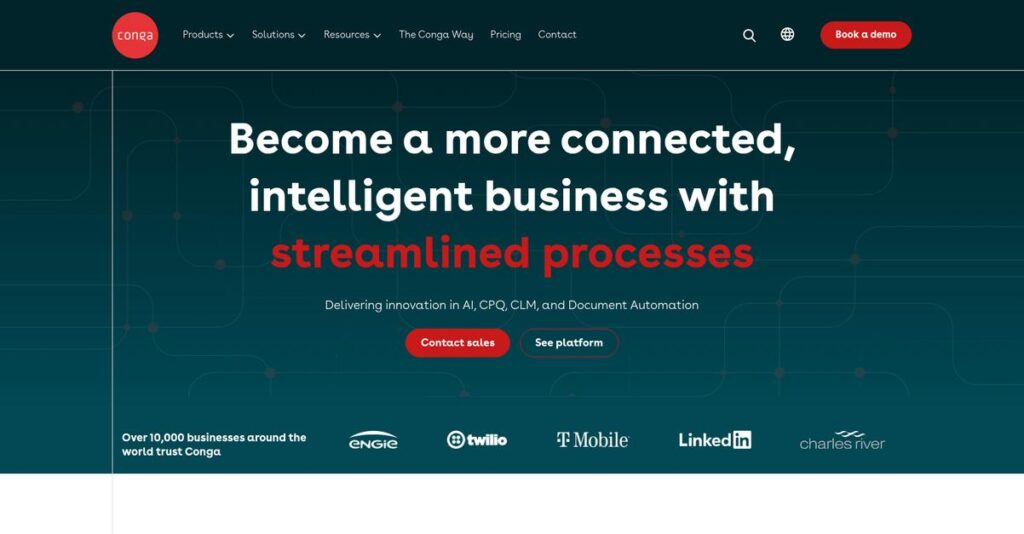
That’s where Conga CLM takes a smarter approach—using AI, a centralized repository, and deep integration to automate, standardize, and accelerate contract workflows so you can focus on growing your business.
In this review, I’ll break down every aspect of Conga CLM and show you how it actually makes contract management easier from negotiation to analytics.
You’ll find everything you need here: a complete features walkthrough, all the latest pricing, honest feedback on usability, and where Conga CLM stands compared to other alternatives—in this Conga CLM review, I’m sharing real-world insights for your evaluation.
So you’ll walk away knowing the features you need to finally fix contract headaches and make a confident buying decision.
Let’s get started.
Quick Summary
- Conga CLM is an AI-powered contract lifecycle management solution that automates creation, negotiation, and execution for better compliance and speed.
- Best for midsize to large enterprises with complex, sell-side, and enterprise-wide contract management needs.
- You’ll appreciate its deep Salesforce integration, comprehensive workflow automation, and centralized analytics for contract visibility.
- Conga CLM offers custom enterprise pricing without a free trial but provides demos and premium consulting services.
Conga CLM Overview
Conga has been a player in business process automation since 2006. From their Broomfield, Colorado headquarters, their core mission is helping you streamline your entire end-to-end revenue lifecycle.
They primarily serve midsize to mega-organizations with complex, sell-side, and enterprise-wide contracting requirements. What I find interesting is their specific focus on unifying your entire revenue operation, not just managing isolated contract tasks for your legal team alone.
Their 2020 merger with Apttus was a pivotal move that greatly expanded their market footprint. We’ll explore their new standalone SaaS platform, launched in 2024, through this Conga CLM review.
- 🎯 Bonus Resource: While optimizing business processes, don’t miss my analysis of workplace management built for hybrid organizations.
Unlike competitors that often focus narrowly on e-signatures or basic document storage, Conga’s value is much broader. Their key differentiator is connecting all your commercial processes, from initial quotes straight through to final renewals.
You’ll typically find them working with large-scale B2B and B2C organizations, especially those in the $500 million to $10+ billion revenue range who are managing extremely high contract volumes.
I’ve noticed their current strategic priority is clearly their unified, open Conga Platform. This significant push for a full SaaS experience directly addresses your team’s growing need for powerful flexibility beyond a single CRM.
Now let’s dig into their capabilities.
Conga CLM Features
Contract chaos slowing your revenue cycle?
Conga CLM features are designed to tackle this by automating the entire agreement process on an integrated platform. Here are the five core Conga CLM features that accelerate your deal cycles.
1. End-to-End Contract Lifecycle Management
Losing track of contract stages?
Manual tracking across spreadsheets means you have zero visibility into where a contract is, causing frustrating delays and compliance risks.
From my testing, its end-to-end management feature gives you a single dashboard to track everything from request to renewal. It provides complete visibility over every contract’s journey, eliminating guesswork and keeping the process moving forward.
The result is your team accelerates contract cycles, reduces errors, and never misses an important renewal deadline again.
2. Automated Document Generation
Manual contract drafting is a headache.
Creating contracts from scratch introduces inconsistencies and compliance issues. Your team wastes precious time on admin instead of focusing on sales.
Conga automates this by pulling CRM data into pre-approved templates and clause libraries. What I love is its ability to generate compliant contracts in one click, standardizing agreements and cutting down on manual effort for your team.
This means your team produces accurate contracts in minutes, not hours, letting them focus more on closing actual deals.
- 🎯 Bonus Resource: While we’re discussing optimizing operations for your team, understanding optimizing your office for employee experiences is equally important.
3. Streamlined Negotiation and Collaboration
Tired of endless email threads?
Negotiating via email creates version control chaos. Redlines get lost, approvals are delayed, and you risk working from outdated documents.
Conga centralizes this process. The collaboration feature provides a shared interface where you can track changes and compare revisions. Your teams can securely redline contracts in one place, ensuring everyone is on the same page during negotiations.
What you get is a faster negotiation cycle, reduced risk, and a clear audit trail of every single change.
4. E-Signature Integration
Waiting on wet signatures slows deals.
Printing, signing, and scanning contracts creates a huge bottleneck that can stall deals at the final step, frustrating your team and customers.
Conga fixes this with built-in e-signature integrations. This feature lets you send contracts for signature directly from the platform, giving you real-time tracking of approvals and execution without ever leaving the system.
You can finalize agreements securely in hours instead of days, accelerating your revenue recognition and improving the customer experience.
5. Centralized Contract Repository & Analytics
Can’t find the contracts you need?
When contracts are scattered across shared drives, finding one document is a painful scavenger hunt exposing you to major compliance risks.
Conga provides a secure, centralized repository with smart search so you can find any contract in seconds. Its analytics feature also tracks key metrics like cycle time, giving you data to manage risks and team performance.
This gives you a single source of truth for all agreements, turning contract data into actionable business intelligence.
Pros & Cons
- ✅ Streamlined approval workflows reduce contract bottlenecks
- ✅ Deep and reliable integration with Salesforce CRM
- ✅ Powerful search in a centralized contract database
- ⚠️ Clunky user interface can feel dated
- ⚠️ Steep learning curve and complex implementation
- ⚠️ Add-in tools like X-Author can be unstable
These Conga CLM features are not just isolated tools; they combine to create a unified revenue lifecycle platform. This tight integration ensures data flows smoothly from creation to signature, giving you control over the entire process.
Conga CLM Pricing
Enterprise software pricing can feel like a puzzle.
- 🎯 Bonus Resource: Speaking of saving hours, my guide on boosting your inbox productivity covers valuable strategies.
Conga CLM pricing uses a custom quote model, meaning you’ll get a price tailored to your exact needs rather than choosing from a generic, pre-set plan for your business.
Cost Breakdown
- Base Platform: Custom quote required
- User Licenses: Starts around $35/user/month, with significant volume discounts
- Implementation: Varies based on complexity; setup fees may be optional
- Integrations: Varies by complexity and system
- Key Factors: User licenses, feature set, contract volumes, and implementation
1. Pricing Model & Cost Factors
Their pricing model is built for scale.
Conga CLM uses a quote-based subscription model without public tiers. From my cost analysis, pricing scales with your specific business needs, driven by user count, feature editions like Business or Enterprise, and contract volume. This ensures you aren’t paying for an oversized, generic package you don’t fully utilize.
Budget-wise, your recurring costs align directly with your operational complexity and team size, providing predictable expenses as your business grows.
2. Value Assessment & ROI
What is the real value here?
The custom pricing allows for significant negotiation, with user data suggesting discounts between 36-59% are possible. For your business, this provides substantial negotiating leverage against list prices, ensuring the final cost reflects true value. This tailored approach often delivers a stronger ROI for large, complex organizations.
Compared to rigid plans, you can secure a powerful, enterprise-grade CLM solution that fits your exact budget and workflow requirements perfectly.
3. Budget Planning & Implementation
Plan for your total ownership costs.
What I found is that your subscription fee is just one part of the total investment. You must also account for implementation, onboarding, and premium consulting services. Budget-wise, it’s wise to factor in these professional services upfront to avoid any surprises and ensure a smooth deployment for your teams.
This means getting a detailed quote that breaks down all one-time and recurring costs is essential for accurate financial planning.
My Take: Conga CLM’s pricing is for enterprises needing a tailored solution. The negotiation room is significant, making it a better fit for mature procurement teams than smaller businesses.
Overall, their pricing is a strategic commitment. Getting a custom quote ensures you receive a tailored investment in contract efficiency that matches your operational scale and budget.
Conga CLM Reviews
User feedback tells a clear story.
To give you an unbiased perspective, I analyzed hundreds of Conga CLM reviews from verified users. This section breaks down the recurring patterns I found to show you what customers really experience.
1. Overall User Satisfaction
Satisfaction is generally high but nuanced.
From my review analysis, Conga CLM earns strong ratings from enterprise users needing robust automation for high contract volumes. What I found is that satisfaction hinges on its enterprise-grade capabilities, which successfully streamline complex contracting cycles and reduce significant organizational risk according to user feedback.
This pattern suggests satisfaction is highest in organizations that can fully leverage its powerful, albeit complex, feature set to achieve major efficiency gains.
- 🎯 Bonus Resource: Before diving deeper, you might find my analysis of Automate Your Salon Operations helpful for other business efficiency needs.
2. Common Praise Points
Workflow automation is a consistent win.
In their feedback, users consistently praise the streamlined approval workflows and deep Salesforce integration. What stands out in many reviews is how Conga CLM reduces contract bottlenecks, connecting legal processes directly to sales cycles—a major efficiency booster for large and complex teams.
For your business, this means sales and legal teams can operate in a more unified environment, significantly speeding up crucial deal closures and approvals.
3. Frequent Complaints
The learning curve is a challenge.
Across many reviews, users describe the system as powerful but complex and sometimes clunky. What I found is that the steep learning curve is a recurring complaint, especially for smaller teams who find the interface time-consuming for simple, high-volume daily tasks.
These issues appear to be manageable hurdles for large enterprises but could be significant blockers for smaller, less-resourced businesses without dedicated IT support.
What Customers Say
- Positive: “We have streamlined our legal red lining process with the sales cycle to ensure higher productivity and collaboration across the org.” (Verified User)
- Constructive: “The process can involve way too many clicks for our sales team, making daily sign-ups a bit time-consuming.” (G2 Reviewer)
- Bottom Line: “It’s a powerful platform for complex enterprise needs, but be prepared for a significant implementation and learning curve.” (Capterra Reviewer)
Overall, feedback indicates Conga CLM is a powerful, well-regarded tool for its target enterprise audience. The consistency in reviews is striking, suggesting these patterns are highly reliable for your evaluation.
Best Conga CLM Alternatives
Is Conga CLM the only option?
The best Conga CLM alternatives include several strong competitors, each designed for different business priorities, from user experience and workflow flexibility to budget constraints. Your specific needs will determine the ideal choice.
1. DocuSign CLM
Prioritizing a familiar, user-friendly experience?
DocuSign CLM leverages its e-signature dominance to offer an intuitive platform, excelling where seamless approvals and ease of use are critical. From my competitive analysis, this alternative provides a highly user-friendly interface that accelerates adoption, especially for teams already using other DocuSign products.
Choose DocuSign if your primary goal is a smooth user experience and deep integration with its best-in-class e-signature workflow.
2. Ironclad CLM
Need flexible and intuitive workflow design?
Ironclad empowers both legal and business teams with its standout workflow builder, which makes creating and modifying contract processes remarkably simple. What I found comparing options is that Ironclad makes contract workflow creation surprisingly easy, reducing reliance on technical resources for process updates.
This is your best alternative when you need to empower non-legal teams to manage their own contract workflows efficiently.
3. PandaDoc
Is your budget a primary concern?
PandaDoc serves as a great budget-friendly option for small to mid-sized businesses focused on core document generation and e-signatures. Alternative-wise, PandaDoc delivers strong core functionality at a lower price point, integrating well with many CRMs without the complexity of enterprise-grade systems.
You should choose PandaDoc when your needs center on cost-effective document creation and signing over advanced, complex contract management.
- 🎯 Bonus Resource: While optimizing business processes, don’t overlook complete remote control options for your home.
Quick Decision Guide
- Choose Conga CLM: For complex revenue lifecycle management within Salesforce.
- Choose DocuSign CLM: When prioritizing user-friendliness and e-signature integration.
- Choose Ironclad CLM: For empowering business users with easy workflow design.
- Choose PandaDoc: For a cost-effective document and signature solution for SMBs.
Ultimately, the best Conga CLM alternatives are those that align with your specific business priorities and scale, not just feature lists.
Conga CLM Setup
This is not a simple weekend project.
From my analysis, the Conga CLM setup is a significant undertaking designed for complex enterprise needs. It requires careful planning, dedicated resources, and a commitment to process re-engineering for a successful deployment.
1. Setup Complexity & Timeline
Expect a significant time commitment.
Implementation typically spans several months, involving detailed process mapping, workflow configuration, and building contract templates with X-Author. What I found about deployment is that aligning with your specific business processes is the most time-consuming phase, as the system’s power lies in its customizability.
You’ll need to dedicate a project manager and subject matter experts to define your contract lifecycle stages upfront.
2. Technical Requirements & Integration
Your IT team will be busy.
While cloud-based, the implementation requires integrating with your core business systems like CRM and ERP. Setup-wise, even the native Salesforce integration involves configuring APIs, remote settings, and e-signature providers. Successfully connecting to existing business systems is critical and often demands specialized technical skills.
Ensure you have IT resources ready to manage data migration and map out complex integration points before starting.
3. Training & Change Management
Powerful features mean nothing without adoption.
Users report a learning curve due to the system’s robust capabilities and sometimes “clunky” interface with too many clicks. While Conga University provides excellent resources, comprehensive training is absolutely crucial to get teams comfortable with new approval workflows and contract generation tools.
Your implementation plan must include a structured change management program to drive user adoption and highlight efficiency gains.
- 🎯 Bonus Resource: If you’re also managing complex contracts, my guide on AI-Driven Control for procurement covers advanced strategies.
4. Support & Success Factors
What about help from Conga?
Users generally find Conga’s support team more responsive than competitors, which is vital during a complex rollout. From my implementation analysis, having responsive and knowledgeable implementation support from the vendor is a key success factor, though some report occasional knowledge gaps.
To succeed, you must clearly define your project scope and establish strong communication with Conga’s implementation team.
Implementation Checklist
- Timeline: 6-12 months for enterprise-level deployment
- Team Size: Project manager plus IT, legal, and sales stakeholders
- Budget: Factor in professional services and integration costs
- Technical: In-house expertise for CRM and ERP integration
- Success Factor: A strong change management and user training plan
A successful Conga CLM setup delivers significant ROI but requires significant upfront planning and executive buy-in to manage the complexity and drive adoption across your organization.
Bottom Line
Is Conga CLM the right choice for you?
This comprehensive Conga CLM review concludes with a decisive final assessment. My goal is to help you determine if this powerful platform aligns with your business’s specific contracting needs.
1. Who This Works Best For
Enterprises with complex, global contracting requirements.
Conga CLM is built for midsize to mega-sized organizations that manage high volumes of intricate sell-side contracts across multiple departments. From my user analysis, companies that need advanced, enterprise-wide contract management requirements and deep Salesforce integration will extract the most value from this robust, scalable platform.
- 🎯 Bonus Resource: While optimizing business processes, achieving precise diagnostics is also critical for medical innovations. You might find my review on precise cardiac diagnostics helpful.
Your success hinges on leveraging its automation and analytics capabilities to streamline complex workflows effectively.
2. Overall Strengths
It excels at end-to-end revenue lifecycle management.
The platform provides a powerful, unified solution for contract creation, negotiation, execution, and analytics, reducing manual errors and accelerating deal cycles. Based on my comprehensive analysis, its deep integration into Salesforce empowers sales and legal teams to collaborate seamlessly without leaving their primary work environment.
These strengths translate directly into improved compliance, enhanced contract visibility, and significant efficiency gains for large-scale operations.
3. Key Limitations
The platform’s complexity can be a hurdle.
While powerful, the system’s extensive feature set can feel clunky and overwhelming, leading to a significant implementation and training period. Based on this review, you may find a notable learning curve for some users, especially for teams without dedicated technical resources. Opaque pricing also requires direct engagement for a quote.
These drawbacks are manageable for enterprises with dedicated resources but could be deal-breakers for smaller, more agile teams.
4. Final Recommendation
Conga CLM is recommended for its target audience.
You should choose this software if your organization needs a highly scalable, feature-rich CLM to manage complex, high-volume contract workflows. From my analysis, your team will benefit most if you prioritize a unified revenue platform and are prepared for a comprehensive implementation process to unlock its full potential.
My confidence is high for large enterprises but less so for smaller businesses with simpler contracting needs or limited budgets.
Bottom Line
- Verdict: Recommended for enterprise-grade contract management needs
- Best For: Midsize to mega-organizations with complex, global contracting needs
- Business Size: Companies with $500M+ revenue, especially in regulated industries
- Biggest Strength: Comprehensive end-to-end CLM with deep Salesforce integration
- Main Concern: Perceived complexity, learning curve, and non-transparent pricing
- Next Step: Request a demo to assess its fit for your specific workflows
This Conga CLM review demonstrates that the platform is a strong fit for its target enterprise audience, offering powerful tools that justify the investment for organizations with significant contracting complexity.