Tired of tangled speaker wires?
If you’re researching whole-home audio, you’re probably frustrated by messy cabling and the complicated setup that comes with traditional systems.
The real kicker? You end up wasting time troubleshooting unreliable wireless connections and running wires through walls—it’s exhausting and slows down your projects.
Fasetto tackles this head on with AUDIO Cu, their sound-over-power-lines tech that lets you deliver Dolby Atmos audio without pulling a single wire. If you want to modernize your installations or just get better sound at home, this approach could be a game changer.
In this Fasetto review, I’ll break down how you can finally get hassle-free, certified-quality audio—and show you what to expect before you dive in.
You’ll see what makes Fasetto different, how the features stack up, pricing details, and which alternatives you should also have on your radar.
Stick around for the features you need to simplify your audio projects and make a smarter decision.
Let’s dive into the analysis.
Quick Summary
- Fasetto is a power-line audio solution provider that lets you run high-quality surround sound without traditional speaker wires.
- Best for homeowners and integrators needing flexible, wire-free Dolby Atmos setups.
- You’ll appreciate its simple plug-and-play design that allows speaker placement anywhere with a power outlet.
- Fasetto offers pricing through integrators with no public details or free trials currently available.
Fasetto Overview
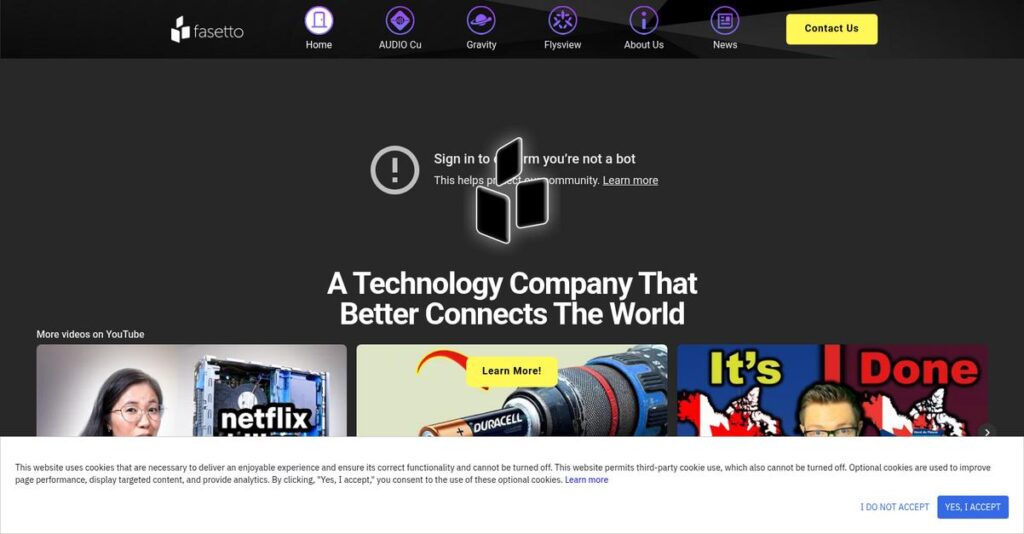
Fasetto’s mission is to redefine digital connectivity and make complex audio and content sharing simple for everyday users and professionals alike. By focusing on cutting-edge IP solutions for content delivery, Fasetto has built strong credibility in the audio technology and device integration space.
They position themselves as a specialist for consumers, AV integrators, and manufacturers, addressing the long-standing pain points of wired and wireless audio setups. Unlike traditional home audio brands, Fasetto leverages power-line transmission and modular platforms so you can build flexible, wire-free sound systems for home theaters, venues, or device OEMs.
Their solutions power residential customers, event venues, and professional integrators—evidenced by deployments in custom AV installations, public venues, and scalable smart homes.
Here’s where Fasetto stands out:
- Certified Dolby Atmos home audio over power lines
- Plug-and-play scalability for homes and venues
- Licensing and embedded options for device manufacturers
Fasetto now prioritizes platform compatibility and user-focused automation to meet the demand for flexible, minimal-effort installations—directly aligning with trends in smart homes and pro AV.
Let’s dive deeper into their capabilities in this Fasetto review, starting with features and real-world use cases.
Fasetto Features
Sick of tangled wires ruining your audio setup?
Fasetto takes a fresh spin on sound distribution by turning your power lines into an audio highway. Rather than just one niche tool, the platform’s AUDIO Cu suite covers multiple scenarios—home, professional, integration, device manufacturing, and local mesh connectivity. These are the five core Fasetto solutions that address the thorniest problems in audio wiring and connectivity today.
1. AUDIO Cu Home
Are ugly speaker wires limiting your home theater dreams?
Trying to chase Dolby Atmos in your living room often means hiding ropes of wire, agonizing over outlet placement, or just living with restricted layouts. That’s pure frustration for any enthusiast.
Fasetto’s AUDIO Cu Home feature lets you connect any HDMI eARC/ARC audio source to as many speakers and subwoofers as you want—right through the power outlets already in your walls. No more running cables or drilling holes behind walls; just plug in, place your speakers, and you’re set for high-fidelity, low-latency surround sound.
With AUDIO Cu Home, you get real flexibility. Atmos, TrueHD, and beyond—your theater can finally fit your room, not the other way around.
2. AUDIO Cu Venue
Events shouldn’t start with hours of cable wrangling.
If you’ve ever managed sound at an expo, club, or conference, you know setting up large audio systems is a headache—power drops, cable runs, and sound checks can take forever.
The AUDIO Cu Venue solution flips the script. You just plug the transmitter into your AV setup, then power each speaker perimeter with receivers—using existing venue power lines for full-range, multi-zone sound. No more layout restrictions or trip hazards, and setup takes minutes, not hours.
For any event producer or venue manager, that means quicker turnarounds, less tech overhead, and greater freedom with staging and show design.
3. AUDIO Cu Connect
Expanding your audio setup shouldn’t require a contractor.
Scaling your sound system—maybe for a growing family room or a new outdoor area—leads to logistical pain: more wires, more clutter, more installation costs.
Fasetto’s AUDIO Cu Connect feature makes expansion modular and dead simple. You just add new AUDIO Cu receivers to any open power outlet, pair them to your system, and enjoy instant multi-room or multi-zone audio. This feature works with all AUDIO Cu products and lets you:
- Add more channels on demand
- Eliminate new wiring costs
- Keep flexibility for future changes
Scalability that keeps pace with your needs—no fuss, just better sound.
4. AUDIO Cu SoC Integration
Integrating wire-free audio tech shouldn’t be a hurdle for manufacturers.
OEMs and device makers want the latest features, but embedding audio transmission in hardware typically means major R&D and compatibility hassles.
With the AUDIO Cu SoC solution, you can drop Fasetto’s power-line audio IP directly into your own TVs, AV gear, or speakers. Manufacturers get a shortcut to wire-free, Atmos-ready audio at the chip level—future-proofing your products and eliminating external dongles or adapters for users.
Faster innovation, wider compatibility, and a smoother customer experience—that’s a business advantage no device company should ignore.
- 🎯 Bonus Resource: While we’re discussing business advantage, understanding digital agronomy & agribusiness growth is equally important.
5. Gravity Framework
Internet outages shouldn’t cripple your device connectivity.
Relying on the cloud for data transfer is risky, and mesh systems are often locked behind proprietary hardware or require internet to function.
With Fasetto’s Gravity Framework, you get a local, edge-based mesh network using Bluetooth and Wi-Fi. Devices auto-detect, collect, share, and act on data without the cloud. This Fasetto feature brings you self-aware, always-on device ecosystems for everything from digital signage to IoT solutions:
- No central server downtime
- Flexible for Android, Windows, Linux
- Efficient for real-time applications
Gravity cuts your reliance on the internet, improving resilience and privacy in your deployments.
Pros & Cons
- ✅ Eliminates traditional speaker wiring hassles
- ✅ Quick modular setup for home and venues
- ✅ Enables low-latency, high-fidelity audio everywhere
- ⚠️ Limited adoption among third-party AV brands
- ⚠️ Premium hardware cost compared to basic systems
What makes these Fasetto features click is how they all interlock. You can expand across home, professional, and device maker needs with one modular system, letting you grow or adapt your audio deployment as your requirements change. Ready to see how it actually performs? Let’s dive deeper.
Fasetto Pricing
Pricing can feel confusing without transparent numbers.
Fasetto pricing uses a custom quote model tailored to each buyer’s installation size, channel, and feature requirements. Since AUDIO Cu is distributed via integrators with no published pricing tiers, you’ll need to connect with Fasetto or a certified partner for a personalized estimate. I’ll break down your cost considerations and value factors below for clarity.
Cost Breakdown
- Base Platform: Custom quote
- User Licenses: Not applicable—hardware system
- Implementation: Varies by integrator/project scope
- Integrations: Varies by complexity
- Key Factors: Number of zones, audio specs, install needs
1. Pricing Model & Cost Factors
No two installs cost the same.
Fasetto uses a project-based pricing structure, with your total outlay depending on variables like room count, power line infrastructure, and feature set. The main drivers are implementation complexity, required hardware, and system configuration. You’ll want to scope your requirements directly with Fasetto or an integrator to get firm numbers.
For your budget, this means you’re in control—your system spec and install needs shape what you pay next.
2. Value Assessment & ROI
Here’s how the pricing delivers value.
- 🎯 Bonus Resource: If you’re also looking into enhancing your content with audio, my article on boosting audio production for free covers Text-to-Speech solutions.
Traditional wired speaker installs often rack up labor and cabling costs. Fasetto pricing is designed to offset these with its unique sound-over-power approach. You pay for high fidelity audio with no new wiring required. For venues or homes where retrofits are tough, the ROI comes from both install savings and future ease of expansion.
Your total investment compares favorably to similar premium audio systems—especially as you scale, or avoid expensive rewiring.
3. Budget Planning & Implementation
Watch for total ownership costs.
It’s not just the hardware. Make sure you factor in your integrator’s labor, any specialized power adapters, and future upgrades when budgeting Fasetto pricing. Look at ongoing support or expansion as part of total cost. Ask for itemized quotes that break down each segment for smart budget planning.
To get full visibility, request a turnkey proposal, and compare with what competing premium setups would actually require for similar coverage.
My Take: Fasetto’s pricing approach is a fit for buyers who want a future-proof sound system that costs less to install as complexity rises—especially commercial or premium home environments where hiding wires is hard and reliability is key.
For those seeking pricing clarity, Fasetto’s value comes from control and simplicity—you only pay for exactly what you deploy. The best move is to outline your requirements and request a custom quote for your project.
Fasetto Reviews
Are real users loving Fasetto’s promise?
I’ve closely examined early Fasetto reviews, focusing on aggregate feedback from tech outlets, users, and hands-on impressions. Here’s what you should know about what people are actually saying about their AUDIO Cu audio-over-power-lines system, including satisfaction drivers, what gets praised most, and hot-button drawbacks.
1. Overall User Satisfaction
Most users sound genuinely impressed so far.
Early reviews show a strong trend toward positive sentiment, with users highlighting the freedom from speaker wiring as a universal improvement. Many mention the unique convenience of simply plugging speakers into outlets—and that setup genuinely feels modern. While comprehensive star ratings are limited, nearly all initial comments paint the experience as a breath of fresh air versus complicated setups.
Satisfaction comes from the “just works” installation, immersive sound (including Dolby Atmos), and the ease of speaker placement almost anywhere power exists.
- 🎯 Bonus Resource: While we’re discussing creating an immersive sound experience, understanding how to enhance your audio for creator content is equally important.
2. Common Praise Points
Setup simplicity tops the praise list.
Nearly everyone commenting on Fasetto reviews highlights a few recurring benefits: Plug-and-play setup, no need for running speaker wires, and intuitive mobile app control. Users stress that “freedom from wires” is the biggest advantage. Features like controlling listening modes or EQ from your phone offer additional appeal and make day-to-day use feel streamlined.
For you, these features mean you can expect faster home theater installation and an easy way to optimize your listening experience without any wiring headaches.
3. Frequent Complaints
There are a few limitations across reviews.
Some critical reviews point out dependency on having power outlets close to every speaker. People note “outlet location can limit ideal placement.” Occasional discussion also surfaces around whether electrical interference could become an issue—though most mention this hasn’t yet been a real problem. Support for only passive speakers is another commonly noted current limitation.
If you’re renovating, missing outlets may affect flexibility. Still, most see these as inconveniences, not deal-breakers, especially weighed against the system’s advantages.
What Customers Say
- Positive: “No speaker wires, no hassle—just plug in and go.” (AVSForum user review)
- Constructive: “You need outlets in just the right spots for each speaker.” (Reddit early adopter)
- Bottom Line: “Easiest home audio setup I’ve tried, unbeatable convenience.” (Digital Trends hands-on)
What you should take away is that early reviews suggest strong satisfaction with the convenience and audio quality, while user feedback remains consistent and credible so far.
In Conclusion
Is this the right fit for your setup?
When wrapping up this Fasetto review, I want to give you the clarity you need to make a confident decision. Here’s my decisive take on where this system excels, who benefits most, and when you might want to look elsewhere.
1. Is Fasetto for you?
Perfect for audio enthusiasts and integrators.
If your business lives and breathes flexible, high-fidelity sound solutions without wiring hassles, Fasetto’s AUDIO Cu stands out. This solution is best if you’re outfitting home theaters, event venues, or commercial spaces and crave minimal installation complexity with Dolby Atmos performance. Small-to-midsize businesses, AV integrators, and tech-forward pros will see the most practical value.
You’ll be most successful if your setups demand fast deployment, flexibility in speaker placement, and you’re comfortable working with passive speaker hardware.
2. Overall Strengths
Wiring headaches finally solved for good.
Fasetto excels by eliminating speaker cabling with true plug-and-play audio over power lines. My review found the system’s mobile app, Atmos support, and latency/buzz mitigation deliver real-world benefits over competing wireless and wired solutions. Early setup experiences suggest the system is intuitive and scales well for both home and larger venues.
These strengths mean your team can install, expand, or reconfigure high-quality audio with far less friction—translating to faster projects and superior listening experiences.
3. Key Limitations
Some practical limitations to weigh carefully.
Right now, Fasetto only works with passive speakers and available power outlets. The lack of published pricing and limited user reviews are also worth noting. Depending on your venue, you may find outlet placement limits your ideal speaker setup, and getting more from this system means waiting for future hardware integrations.
Most limitations aren’t deal-breakers if you prioritize wiring-free simplicity, but confirm your speaker needs and room layout before committing to AUDIO Cu.
4. Bottom line?
A forward-thinking pick for wiring-free audio.
If you’re ready to ditch speaker wiring and prioritize setup speed, Fasetto is worth your shortlist. My review suggests it’s best for tech-forward businesses or AV professionals who value simplicity, flexibility, and Dolby Atmos quality, but rely on passive speaker systems.
I recommend starting with a live demo or pilot install—confidence is high for the right business, especially when flexibility and hassle-free installs are paramount.
Bottom Line
- Verdict: Recommended
- Best For: AV pros, integrators, tech-forward venues
- Business Size: Small to midsize, scalable for venues
- Biggest Strength: Zero speaker wiring and flexible placement
- Main Concern: Needs passive speakers, outlet proximity
- Next Step: Book a live demo or pilot
Bottom line, this Fasetto review points to a software that’s ahead of the curve—if you match the ideal user profile, you can confidently go forward with your decision and see if the benefits outweigh the limitations.