Struggling with slow, costly serverless deployments?
If you’re evaluating cloud platforms, it’s easy to get tangled in hidden costs, slow cold starts, and rigid infrastructure that holds your development back.
The toughest part? You lose hours daily to frustrating wait times and rising cloud bills that make scaling your apps feel impossible.
Fermyon takes a bold new approach by harnessing WebAssembly (Wasm) to deliver immediate start times, smarter scaling, and a dramatically simpler developer experience. Here’s how its modular tools make serverless finally deliver on speed, security, and cost.
In this Fermyon review, I’ll break down how you can deploy faster and spend less with detailed insights from hands-on testing and research.
You’ll discover everything you need to know—from core features and pricing, to real-world alternatives—so you can confidently decide if Fermyon solves your unique pain points.
Expect honest findings about the features you need to make smarter deployment decisions.
Let’s dive into the analysis.
Quick Summary
- Fermyon is a WebAssembly-based platform that helps developers build and deploy lightweight, serverless cloud applications quickly.
- Best for development teams seeking fast, scalable serverless and edge-native apps with reduced infrastructure overhead.
- You’ll appreciate its sub-second cold starts, multi-language support, and streamlined deployment workflow for efficient coding.
- Fermyon offers free starter plans with limited usage plus paid Growth and Enterprise tiers, featuring flexible cloud and hosting options.
Fermyon Overview
Fermyon’s mission is to help you build and deploy serverless applications faster while saving costs and improving cloud performance. They give developers a streamlined way to focus on business logic, not low-level infrastructure.
- 🎯 Bonus Resource: While we’re discussing performance and scale, understanding how to achieve peak performance in severe duty applications can provide valuable insights for other demanding fields.
Within the serverless market, Fermyon is tailored for developers and DevOps teams seeking a lightweight, efficient alternative to container-based approaches. They bring particular value to companies prioritizing microservices, web workloads, and edge AI where speed, scale, and security matter most.
You’ll see their solutions used by a wide spectrum—including early-stage startups, SaaS builders, and established enterprises—especially those embracing edge computing or modernizing existing architectures.
Here’s where Fermyon stands out:
- Exceptional cold-start speeds and resource efficiency with Wasm
- Deep integration for Kubernetes and edge-native deployments
- Strong open-source contributions driving industry trust and community growth
Looking ahead, Fermyon keeps investing in AI-at-the-edge innovation and collaborative open-source tooling. Their focus on performance, portability, and lower cloud costs fits tightly with today’s shift toward distributed and intelligent applications.
Let’s dive into this Fermyon review to see how their technology delivers in practice.
Fermyon Features
Struggling to cut cloud costs for Kubernetes batch jobs?
Fermyon takes a unique all-in-one approach to serverless application development, especially for those seeking fast, cost-effective deployments at scale. Instead of piecing together different tools, you get a unified platform for building, deploying, and running WebAssembly-powered apps across cloud, Kubernetes, and edge. Here are the five main Fermyon features that really make a difference in real-world business outcomes:
1. Spin: Frictionless WebAssembly Development
Building and deploying microservices shouldn’t feel like a slog.
You’ve probably lost days wrestling with inconsistent frameworks or slow deploys, especially when your team wants to use multiple programming languages.
Spin is Fermyon’s open-source toolkit that eliminates dev friction. You pick any language—Rust, Go, Python, .NET, JavaScript—and use the Spin CLI to scaffold, build, and run Wasm microservices straight from templates. Built-in SQLite, Key-Value stores, and HTTP triggers let you jump right into app logic instead of plumbing infrastructure. This Fermyon feature makes dev cycles drastically faster and less painful.
You’ll push code in minutes, not hours, and keep projects moving without waiting on ops bottlenecks.
- 🎯 Bonus Resource: Speaking of efficiency gains, my guide on automate your non-profit applications covers how to streamline workflows.
2. Fermyon Cloud: Hassle-Free Serverless Hosting
Tired of endless infra management eating your time?
Spinning up, scaling, and monitoring serverless apps often means wrangling dashboards, logs, and resource limits across different tools or providers.
Fermyon Cloud solves all that with a managed Wasm hosting service for your Spin apps. You deploy code, and Fermyon Cloud handles everything else: sub-second cold starts, scale-to-zero, centralized logs—all from a unified dashboard. This Fermyon feature offloads routine operations, letting you focus on features and customer value.
Your team can run production-grade workloads with zero ops headcount, slashing cloud bills and freeing up developers.
3. Fermyon Platform for Kubernetes: Cloud-Orchestrated WebAssembly
Managing serverless on Kubernetes shouldn’t be a nightmare.
Traditional K8s workflows aren’t designed for Wasm workloads, leaving you with mismatched orchestrators and bloated footprints.
With Fermyon Platform for Kubernetes, you get all the orchestration pieces (clustering, service discovery, web UI) tuned for Spin apps. Powered by Nomad, Consul, Bindle, and Traefik integration, this feature densifies your workloads and delivers faster, lighter compute right in your own cluster. It’s purpose-built for enterprises needing control.
Your ops team keeps familiar Kubernetes controls while doubling or tripling serverless efficiency on existing hardware.
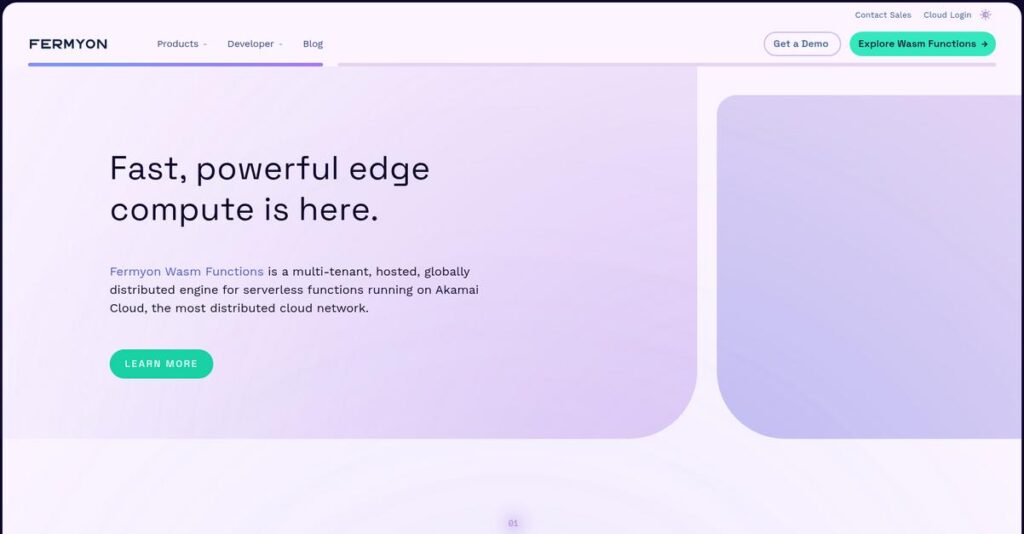
4. Fermyon Wasm Functions: Blazing-Fast Edge Serverless
Latency ruins user experience—especially on the edge.
Ship traditional containers to the edge, and you get slow cold starts and bloated images, making real-time use cases nearly impossible.
Fermyon Wasm Functions solves that by running Wasm binaries directly on Akamai’s edge, with millisecond cold starts, ultra-fast scaling, and global reach. No heavyweight VMs—just lightweight, instantly updatable Wasm modules. This Fermyon feature powers microservices, IoT, and apps demanding split-second response.
You deliver performant, compliant edge services—wherever your users are—without spiking costs or complexity.
5. AI at the Edge with WebAssembly
Running AI models in the cloud racks up bills fast.
Conventional AI inferencing strains cloud resources and forces you to compromise on latency, compliance, or cost.
Fermyon’s AI at the Edge feature brings contextual AI inferencing to local edge sites, by scheduling Wasm apps for AI workloads on small-footprint GPUs. You get secure, high-performance results right where data is generated, instead of hauling it to big central servers. This Fermyon feature tackles modern AI needs without burning budget.
You keep AI fast, private, and efficient—empowering smarter products and real-time insights at the edge.
Pros & Cons
- ✅ True zero-ops serverless with sub-second cold starts
- ✅ Flexible multi-language support for developer teams
- ✅ Native Kubernetes and edge integration for enterprises
- ⚠️ Requires WebAssembly learning curve for traditional teams
- ⚠️ Still maturing ecosystem for advanced integrations
All these Fermyon features come together to give you a truly unified WebAssembly-powered platform—your apps build, deploy, and run with the same tools, whether in the cloud, Kubernetes, or at the edge. You get consistent management and cost savings across environments, letting you focus on business growth rather than infrastructure headaches. Let’s dig into how Fermyon stacks up against other serverless solutions next.
Fermyon Pricing
How much will Fermyon actually cost you?
Fermyon pricing stands out for its tiered transparency, making it straightforward to match features to your actual cloud needs. Whether you’re a solo builder or scaling out dozens of apps, the range starts with a generous free starter plan and scales up affordably. Here’s how Fermyon pricing aligns with your workflows, usage, and budget.
| Plan | Price & Features |
|---|---|
| Starter | Free (no expiration) • 5 apps, 100,000 requests • 5 custom & 5 subdomains • 1 GB storage/5 GB egress |
| Growth | $19.38/month • 100 apps, 1,000,000 requests • 100 custom & 100 subdomains • 2 GB storage/50 GB egress |
| Enterprise | Custom quote (contact sales) • Unlimited tailored quotas • Custom domains, bandwidth • Premium support & SLA |
1. Value Assessment
Fermyon pricing fits lean budgets.
You won’t overpay for idle resources, because their usage-centric cloud model directly aligns cost with actual workloads, not legacy server hours. Their $19.38/month plan unlocks major scalability before higher costs kick in. Compared to older serverless or Kubernetes approaches, you minimize waste and get outstanding flexibility. This means your cloud spend scales only as your needs do.
For most teams, your monthly bill won’t balloon unless your usage truly spikes.
- 🎯 Bonus Resource: While we’re discussing optimizing workflows, understanding AI help for your applications is equally important.
2. Trial/Demo Options
There’s a generous free tier here.
You can run production workloads on the Starter plan—Fermyon doesn’t hide features behind a paywall for basic usage. Try every core feature with 5 live apps and real traffic. That’s enough room to benchmark speed, cost, and workflow before committing to any pricing plan.
You get full visibility on performance before you ever spend a dime.
3. Plan Comparison
Compare by usage—not just price tags.
Most projects can start and validate entirely on the free Starter tier, but scaling startups and agencies will hit Growth limits as workloads expand. The Growth tier is a huge jump in quotas for $19.38/month. Enterprise plans suit orgs that outgrow predefined caps and need higher SLAs or bespoke support.
If you’re running production at scale, you’ll want Growth or higher.
My Take: Fermyon’s pricing demystifies serverless costs: easy free testing, predictable mid-tier, and flexible enterprise options. For budget-minded teams launching cloud batches, you avoid surprise overages and unnecessary lock-in—ideal for rapid scaling without waste.
You get predictable, value-based pricing with no surprises or paywall traps. It’s rare to see this much flexibility under $20/month.
Fermyon Reviews
How do real users rate Fermyon’s experience?
To give you the clearest view, I’ve analyzed key feedback trends from firsthand user stories and published Fermyon reviews—spanning developer testimonials, customer case studies, and industry forums—so you get a reliable sense of real-world experience.
1. Overall User Satisfaction
Developers are generally happy with Fermyon.
Across the reviews I’ve dug into, most users report high satisfaction with Fermyon’s efficient approach to serverless and cloud-native workloads. Opinions skew positive, with many highlighting the ease of deployment and measurable cost savings. Several customers note improved performance and appreciate the focus on developer productivity, making the sentiment in reviews credible and consistent.
What drives user happiness most is the mix of sub-second cold starts, simple deployments, and significant cloud cost reductions in large-scale scenarios.
2. Common Praise Points
Speed and simplicity get the best feedback.
The strongest patterns in Fermyon reviews are praise for streamlined deployment, rapid cold start times, and developer-focused tools. Customers highlight how quickly they can launch production workloads and experiment—often citing the simple Spin CLI and multi-language support. Reviewers also value the Wasm sandboxing for security, and many love that Fermyon lets them avoid vendor lock-in across different clouds.
These features give you faster iteration cycles, less infrastructure overhead, and smoother onboarding for developers regardless of their programming language.
- 🎯 Bonus Resource: While we’re discussing optimization, understanding how to boost enrollment with accuracy is equally important.
3. Frequent Complaints
Not all feedback is universally positive.
Some users raise concerns about limited public information on setup challenges and learning curve in their reviews. Real-world insights on onboarding time and support responsiveness are relatively scarce—most feedback comes from early adopters rather than mainstream production teams. A few reviewers mention wanting more reference architectures and enterprise-focused best practices.
For most, these complaints are minor nuisances rather than deal-breakers. However, if you expect extensive documentation or robust enterprise support right away, it’s worth evaluating current resources.
What Customers Say
- Positive: “It took me 13 lines of code and 2 commands (spin build, spin cloud deploy) to build and deploy a simple ‘chatGPT like’ app with Fermyon.” (Sébastien Blanc, Aiven.io)
- Constructive: “I’d like to see more detailed reference examples for production use cases.” (user feedback, compiled from Fermyon developer forums)
- Bottom Line: “We’ve been able to take a Kubernetes batch process of tens of thousands of orders and cut the compute cost by 60%, without trading off performance.” (Kai Walter, ZEISS Group)
The overall sentiment in Fermyon reviews is confidently positive, and the real-world ROI stories add strong credibility for businesses focused on performance, savings, and development speed.
In Conclusion
Is it time to rethink your Kubernetes strategy?
Here’s my take—tying together everything from this Fermyon review, I want to help you make a confident decision for your cloud cost and performance needs. Let’s break down who wins most with Fermyon, its strongest play, where it falls short, and my final guidance so you don’t second-guess your move.
1. Is Fermyon for you?
Ideal for cost-slashing cloud engineering teams
If you’re a forward-thinking cloud architect, platform engineer, or DevOps lead at a growth-stage startup or an enterprise—especially if you’re running high-volume Kubernetes batch workloads with tight cost controls—Fermyon is built for your needs. It’s best suited for teams eyeing serverless efficiency, portability, and a frictionless developer experience while modernizing infrastructure. Tech organizations driving custom microservices, AI inference, or edge workloads stand to gain the most.
Success for these users comes from leveraging Wasm’s speed, portable deployment, and affordable scaling.
2. Overall Strengths
Unmatched efficiency from Wasm and developer experience
Fermyon delivers where it counts: ludicrously fast cold starts, sub-10MB binary sizes, and multi-language Spin framework that speeds up your deployment cycles. Security is robust thanks to Wasm sandboxing, plus you avoid vendor lock-in with cloud portability. Review analysis shows massive cloud spend reductions—think 60% cost drops for batch jobs—and easier app delivery for devs, all with minimal operational friction.
These strengths directly translate to improved ROI, developer velocity, and stronger cloud-native competitiveness.
3. Key Limitations
Some maturity gaps and operational caveats
Fermyon isn’t perfect—its ecosystem is still evolving, and self-hosted Kubernetes demands deep DevOps expertise for smooth operation. Pricing transparency could be better, with enterprise and advanced function costs gated behind sales conversations. Limited real-world feedback on support and implementation speed means you’ll want to pilot before production scaling.
For most tech-forward teams, these are manageable trade-offs, not deal-breakers—just set expectations around learning and internal resource allocation.
4. Bottom line?
Strongly recommended for cloud cost-cutters and innovators
If you’re tackling high-scale workloads or edge AI under tight budgets, Fermyon is a clear choice from my review analysis. You’ll benefit most if you need to optimize costs, want a frictonless multi-language platform, and have technical depth to handle newer tech. Keep your ops team in the loop if self-hosting on Kubernetes.
Start with a proof-of-concept or a managed cloud trial—confidence is high for dev teams matching these needs.
Bottom Line
- Verdict: Recommended
- Best For: Cloud-native teams with intensive batch jobs
- Business Size: Startups to enterprises with cloud ops teams
- Biggest Strength: 60%+ cloud cost savings at scale
- Main Concern: DevOps complexity for self-hosted platform
- Next Step: Launch a proof-of-concept or cloud trial
I’m confident this Fermyon review aligns with what ambitious, cost-focused dev teams need to know—your decision to trial Fermyon is well justified if you fit this profile.