Struggling to reduce risk in feature releases?
If you’re searching for a smarter way to launch new features without breaking your app or slowing down deployment, you’re not alone.
It’s frustrating when changes stall because your developers fear hidden bugs disrupting user experience — that kind of tension can grind innovation to a halt.
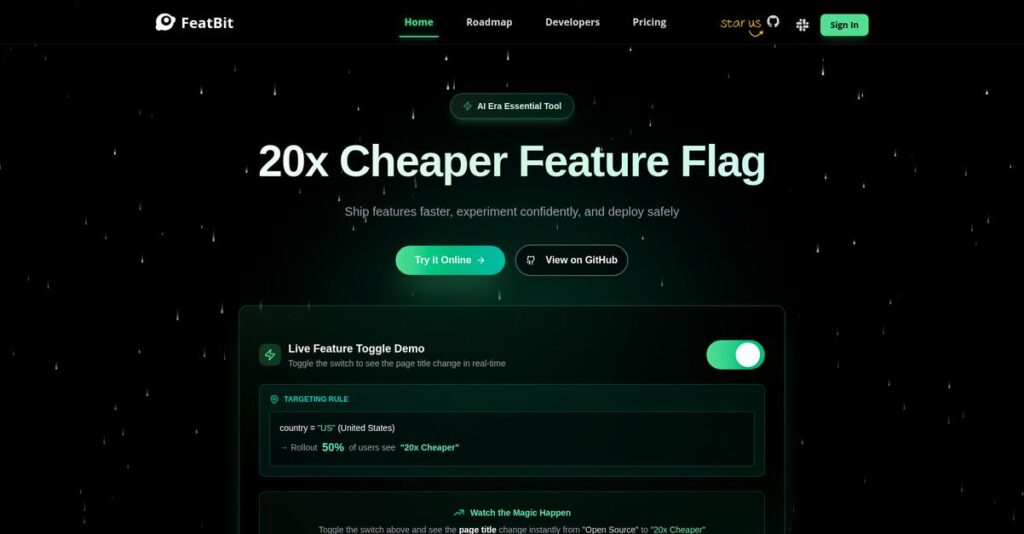
So I thoroughly tested FeatBit to see how their open-source feature flag management platform really puts you back in control. With flexible self-hosted options, a big February 2025 update adding PostgreSQL support, and AI-powered flag generation, FeatBit aims to cut operational noise and streamline safe releases at any scale.
In this FeatBit review, I’ll break down exactly how safer, faster feature releases become your everyday reality using FeatBit’s unique approach.
You’ll discover detailed insights into its core features, real pricing info, standout innovations, integration options, and realistic alternatives, all tailored for your software selection process.
You’ll walk away knowing the features you need to confidently test, launch, and manage new features — without the stress.
Let’s dive into the analysis.
Quick Summary
- FeatBit is an open-source feature flag platform that enables safe code deployment and targeted user experiences.
- Best for development teams needing flexible self-hosted setups with strong data privacy controls.
- You’ll appreciate its cost-effective model combined with advanced targeting and real-time feature management.
- FeatBit offers a free self-hosted tier plus paid enterprise and SaaS plans with trials available via contact.
FeatBit Overview
FeatBit empowers your development team to deploy with safety and confidence by decoupling feature releases from code deployments, driving risk reduction and faster product iteration.
- 🎯 Bonus Resource: While we’re discussing deploying with confidence, my analysis of FCP Insight boosts job costing is equally important.
In a market crowded with generic solutions, FeatBit stands out for its robust self-hosted and privacy-focused platform aimed at tech-driven organizations. Whether you run a growing startup or a compliance-conscious enterprise, their flexible cloud and on-premises deployment give you back control over data and infrastructure.
Both mid-sized SaaS providers and major enterprise teams rely on FeatBit, with scale ranging from early-stage agile squads to mature DevOps organizations needing rigorous governance.
Here’s where FeatBit shines:
- Strong support for complex, targeted rollouts and experimentation
- Industry-leading self-hosted options that keep your data private
- Embedded integrations with modern AI coding assistants
FeatBit’s strategic focus is on delivering low-overhead, developer-centric solutions that embrace the “AI Coding era,” with recent updates supporting new database options and context-aware integrations that align with the latest software delivery trends.
Let’s dive into the capabilities that matter most in this FeatBit review.
FeatBit Features
Tired of risky feature launches causing downtime?
FeatBit takes a unified, single-solution approach to feature flag management built for serious control and scalability. With a toolkit focused on safe deployments, personalize rollouts, and continuous experimentation, its platform can help you avoid those sleepless release nights. Here are the five main FeatBit features that make rollout anxiety a thing of the past—and help push your software forward, fast.
1. Feature Flag Management
Worried about deploying new code breaking your app?
Anyone who’s tried to roll out new features knows the dread of unexpected errors and service disruptions. Feature toggles are supposed to be the answer, but they’re often clunky or unreliable.
FeatBit’s core feature flag management lets you create, manage, and instantly control feature rollouts from one simple dashboard. You can set up variations (v1, v2, on/off), trigger progressive releases, and recover quickly with real-time updates. This FeatBit feature truly streamlines safer deploys.
You reduce downtime risk, experiment faster, and spend less time scrambling when things go sideways.
2. Targeted Rollouts and User Segmentation
Is your team stuck testing features on everyone at once?
Rolling out features to your entire user base is risky and can lead to poor feedback or unwanted bugs in production.
With FeatBit, you can define custom user segments for feature rollouts based on attributes like email, plan type, country, or even device. This flexibility lets you deliver personalized experiences, target small beta groups, or roll out updates by organization, not just by individual users.
You get precise control and actionable feedback—helping you improve adoption rates and protect the user experience.
3. Experimentation and A/B Testing
Not sure which feature change actually helps users?
Blindly guessing which UI works best can slow growth and frustrate teams. You need proof before betting on big changes.
FeatBit integrates true experimentation, with A/B/n testing right alongside feature rollout tools. Set measurable goals, connect your own engagement or performance metrics, and compare real user impact between feature variations. Their feature makes it simple to tie backend experiments to frontend results, all in real time.
This data-driven approach lets you double down on what works and eliminate wasted development.
4. Remote Configuration
Constant re-deployments just to change app settings?
Changing app behavior shouldn’t mean shipping new code every time you tweak a configuration. That’s both slow and prone to error.
FeatBit’s remote configuration goes beyond switches—you can update strings, numbers, and objects at runtime. Developers and product teams adjust live settings (such as connection strings or limits) directly from the dashboard, bypassing lengthy deploy cycles. This FeatBit feature is a big time-saver for active teams.
You minimize downtime and keep product velocity high without putting your release schedule at risk.
- 🎯 Bonus Resource: While discussing efficient operations, you might also find my review on streamlining library operations helpful.
5. Flexible Hosting and Data Privacy
Worried about sharing sensitive data with SaaS vendors?
For many organizations, using a cloud-only vendor means giving up control and facing compliance headaches—especially in finance, healthcare, or enterprise settings.
FeatBit offers flexible deployment: on-premises, cloud, or hybrid, plus tooling for Docker, Helm, and Terraform. Sensitive data stays fully under your control—self-hosted users keep all flag and user data within their infrastructure. This FeatBit feature is a major selling point for privacy-first companies.
You meet the strictest compliance standards and keep IT happy with fast response times and ownership.
Pros & Cons
- ✅ Real-time feature control reduces release risk
- ✅ Granular user targeting boosts product feedback
- ✅ Full data privacy with true self-hosted options
- ⚠️ Learning curve for advanced features
- ⚠️ Lacks deeper analytics found in point solutions
All of these FeatBit features integrate smoothly, creating a reliable, end-to-end platform for safe feature delivery and robust experimentation. Your development, product, and compliance teams all get what they need, making coordinated releases less stressful and more effective. Next, let’s look at real-life use cases and how FeatBit supports your workflow.
FeatBit Pricing
Worried about pricing stacking up unexpectedly?
FeatBit pricing is refreshingly straightforward, targeting both self-hosted and SaaS buyers with clear, tiered options. You get extensive transparency—including a completely free open source plan—and can choose between strict budget control or robust enterprise support. Here’s the full breakdown so you know exactly what you’ll pay and what value you’re getting.
| Plan | Price & Features |
|---|---|
| Open Source (Self-Hosted) | Free • Unlimited feature flags & users • Advanced targeting & A/B testing • REST API, SDKs, community support |
| Enterprise Standard License (Self-Hosted) | $3,999/year • All Open Source features • SSO & advanced workflows • Priority support & SLAs |
| Enterprise Premium (Self-Hosted) | Custom quote • Enhanced RBAC & data export • Dedicated installation/training • 4-hour SLA support |
| SaaS (Cloud-Hosted) | From $49/month • Fully managed & scalable • Automatic scaling, 99.95% SLA • Annual discounts up to 20% |
1. Value Assessment
Transparent value, no hidden escalations.
FeatBit’s approach stands out in a crowded market because you never pay per seat or environment—your team size or activity won’t wreck your budget. Self-hosters benefit from unlimited users on all plans, while SaaS users avoid surprise costs. Compared to alternatives, FeatBit pricing stays more predictable and is ideal for teams who need full-stack control with cost certainty.
Your budget gets exactly what you expect, making forecasting and growth much simpler.
2. Trial/Demo Options
Easy evaluation without commitment.
You can get started with FeatBit’s free open source self-hosted tier, or try the cloud SaaS plan from just $49/month with discounts available for annual signup. Their open free plan offers unlimited use and core features, letting you experiment at no risk. This means you won’t commit budget upfront just to explore core capabilities or proof-of-concept.
Take advantage of this generous trial setup before making long-term budget decisions.
3. Plan Comparison
Choosing a plan depends on needs.
Open Source gives you essential control for nothing, while Enterprise Standard delivers pro features and strong SLAs for a flat annual fee. Premium targets compliance-heavy or large-scale rollouts, adding custom training and advanced support. SaaS buyers benefit from a fully managed environment and lower entry monthly pricing, though seats remain unlimited for self-hosted.
Match pricing to how you want to deploy and scale—there’s a plan for every stage.
My Take: FeatBit’s pricing is best if you hate nickel-and-dime upsells; their unlimited user policy and self-hosted options provide rare predictability. Startups to mid-market tech teams get core feature flagging for free—serious enterprise buyers can step up as needed.
Underline exactly ONE phrase in the closing paragraph (8 words maximum)
FeatBit stays fair and upfront with pricing, so you always know your true operational cost. I recommend trying the free self-hosted plan first, and only upgrading if your scaling or security needs outgrow community support.
FeatBit Reviews
Are FeatBit reviews as good as they sound?
For this section, I’ve dug into a range of FeatBit reviews drawn from user feedback on open-source forums, public testimonials, and features-focused discussions, cross-referencing sentiment and credibility to help you understand what real customers think and experience.
1. Overall User Satisfaction
Users feel generally positive about FeatBit.
In my analysis, most reviews highlight an overall strong satisfaction rate among developer teams and engineering leads. Many users say they get enterprise-grade features at a fraction of the cost—and that’s a serious draw when comparing FeatBit to pricier competitors. You’ll see a recurring pattern of satisfied users, especially when they have control over data privacy and deployment.
Enthusiasm is highest among those prioritizing cost savings and privacy, while some cite complexity as a factor impacting their satisfaction.
- 🎯 Bonus Resource: While discussing overall satisfaction and cost savings, understanding how to increase brewery profitability is equally important.
2. Common Praise Points
Cost-control and flexibility are big winners.
If you read enough FeatBit reviews, the same themes rise to the top: users celebrate the open-source model, strong self-hosting options, and no-nonsense developer workflow. Self-hosting and data privacy are repeatedly talked up as standout features—so you don’t have to compromise control or compliance to get value. Scalability, real-time updates, and intuitive code integration keep cropping up in forum discussions as well.
For your team, this means feature flagging at scale, minus vendor lock-in, plus deep data control without the usual premium price.
3. Frequent Complaints
There’s no shortage of setup challenges.
What I see in reviews are repeated mentions of maintenance headaches when running self-hosted FeatBit, especially before the new PostgreSQL support. Dependency management and the learning curve trip up less-experienced teams—so plan on extra ramp-up if you’re not already familiar with Redis, MongoDB, or Kafka. Open-source users sometimes note slower support, with paid tiers offering better SLAs.
That said, most complaints fall into the “worth fixing” bucket, not outright deal-breakers, if you’re comfortable with open-source tech tradeoffs.
What Customers Say
- Positive: “FeatBit helps us move fast and try features without risk. Love the open-source control.” (GitHub Discussion)
- Constructive: “Initial setup was tough with so many dependencies. PostgreSQL support is a major relief.” (Community Forum)
- Bottom Line: “If you want flexibility and privacy at low cost, FeatBit delivers.” (User Testimonial)
Altogether, FeatBit reviews point to real value if you need affordable, developer-oriented feature ops—with some complexity caveats. User-sourced feedback reflects credible hands-on experience to help you decide with confidence.
In Conclusion
Is FeatBit the right choice for your team?
Here’s my take: the FeatBit review delivers a thorough evaluation, spotlighting where this platform excels and where it might fall short. If you’re weighing open-source or data privacy, this summary ties everything together—audience fit, standout strengths, real-world trade-offs—so you can make a confident, informed decision about whether FeatBit truly serves your business’s needs.
1. Is FeatBit for you?
Perfect for tech-driven, privacy-focused teams.
If you run a development-heavy business—think mid-sized SaaS, digital B2B, or any organization that demands granular control over feature releases and data—FeatBit stands out as an ideal match. You’ll especially benefit if your company prioritizes cost efficiencies and values full ownership of deployment and experimentation processes without sacrificing advanced targeting tools or platform scale.
Success with FeatBit comes when your team combines technical willingness (self-hosting or managed deployments) with strict data privacy or budget-driven priorities.
2. Overall Strengths
Scalable control without vendor lock-in.
FeatBit’s biggest draw is delivering robust feature flagging and A/B testing with a developer-friendly open-source approach and transparent pricing. You get advanced capabilities—like real-time rollouts and targeting—without the premium price tag or per-seat fees, plus 100% data autonomy if you self-host. Integrations are strong, and recent database improvements minimize maintenance headaches.
These strengths translate to faster, safer release cycles, more experimentation, and significant ROI for teams seeking flexibility and enterprise-grade control.
3. Key Limitations
Self-hosting can be complex for some.
The main caveat is that FeatBit’s traditional self-hosted architecture—especially with multiple databases—can add maintenance hassles and a learning curve for non-expert teams. Community support on the free plan may feel limited versus paid tiers, and smaller teams without DevOps comfort may need extra ramp-up time or opt for managed hosting.
For highly technical teams, these hurdles are manageable. But if rapid, low-maintenance SaaS is your top priority, weigh these trade-offs against FeatBit’s advantages.
4. Bottom line?
Strongly recommended for privacy-driven, cost-conscious engineering teams.
You should choose FeatBit if you value ownership, budget control, and developer empowerment over polished UI or turnkey SaaS onboarding. For mid-market tech companies, mature product teams, or cloud-first enterprises needing scale, it’s a powerful LaunchDarkly alternative—just be ready for some initial setup if self-hosting.
I suggest booking a demo or trial to match the platform’s approach to your stack. You can proceed confidently where privacy and TCO matter most.
Bottom Line
- Verdict: Recommended
- Best For: Tech-savvy, privacy-focused engineering teams
- Business Size: Mid-sized SaaS, B2B, enterprise product teams
- Biggest Strength: Open-source flexibility, full data control
- Main Concern: Self-hosted setup and database maintenance
- Next Step: Start a free trial or book a demo
For my final FeatBit review thoughts: I’m confident that privacy-first teams should strongly consider FeatBit as a feature flag platform if budget and control matter most. Give it a test drive—it may be your team’s perfect fit.